
What is a Chaos Garden? Survival of the Fittest, but Make it Vegetables
My garden is a mess.
Not the Instagram mess, either, where the cosmos are still spilling romantically over a cedar raised bed, and someone has artfully left a pair of expensive pruning shears in the foreground that they keep gliding by with their equally expensive linen dress (who does that).
No, I mean a real mess.
I have tomatoes growing in places where I never planted seeds, their leaves curling up the stalks of my sweet corn and poking up from amidst a dense mat of pumpkin vines. I have zucchini plants popping up in the pig pen, flowers that have reseeded themselves alongside our porch stairs, a few patches of stinging nettle that I never got around to pulling because a) I was busy and b) I didn’t want to.
Some of my plants are thriving, others never stood a fighting chance. There are weeds I recognize, weeds I don’t, and more than one section where I’ve decided ignorance is not necessarily bliss, but it’s probably a better mental health strategy than the alternative.
It’s Lord of the Flies, but make it vegetables.
I first heard the term “chaos garden” in Gabe Brown’s book Dirt to Soil, and while my version is probably not exactly what he had in mind (the name of mine more aptly rhymes with “muster duck”), it clicked with me. The idea is simple: instead of planting everything in neat, isolated rows, you mix a variety of plants together and let the system sort itself out.
Survival of the fittest in vegetable form.
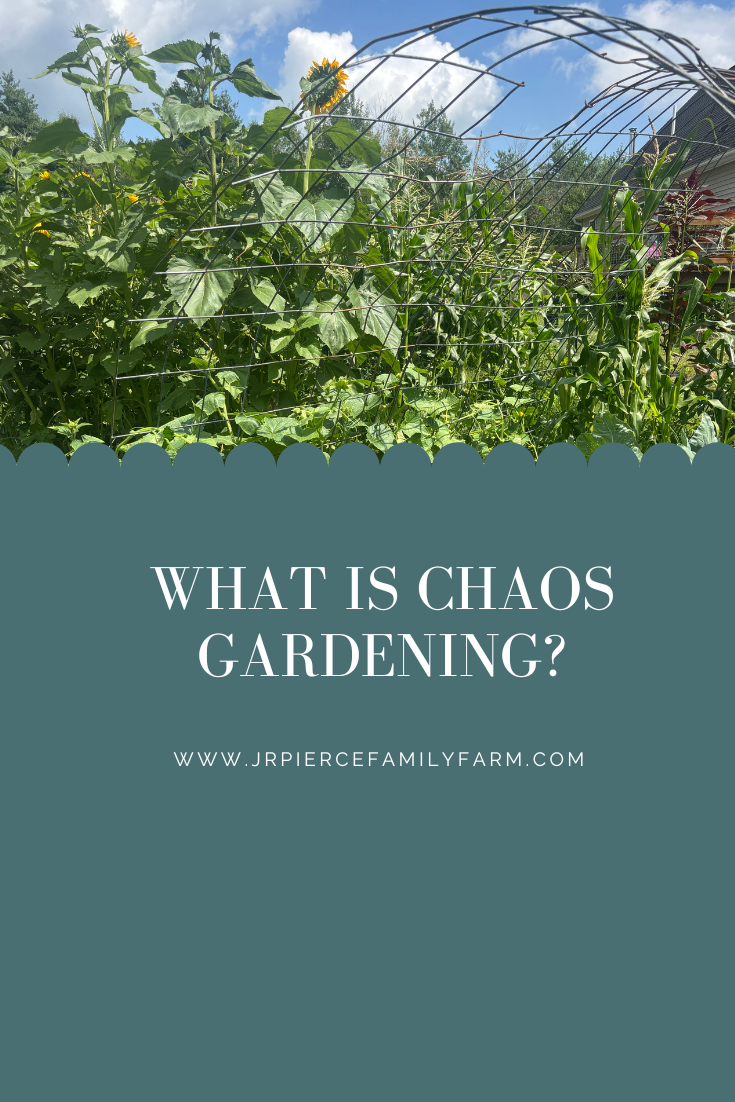
What is a Chaos Garden?
A chaos garden is a deliberately mixed, low-maintenance garden where vegetables, herbs, flowers, and volunteer plants grow together instead of being separated into perfectly ordered rows. Chaos gardening relies more on diversity, observation, and letting plants compete and adapt than on tightly controlling where every plant grows.
The idea is to create more diversity above and below the soil; different plants have different root structures, nutrient needs, growth habits, and relationships with insects and soil life. Put enough variety together, and the garden starts behaving less like a collection of individual plants, more like a tiny ecosystem.
In practice, that might mean vegetables growing alongside herbs and flowers, plants filling in bare soil wherever they can, and volunteers being allowed to stick around instead of immediately getting yanked because they had the audacity to germinate three feet from where they were assigned.
It doesn’t mean doing nothing at all: you still plant, weed, deal with issues when things go sideways. But it is less labor-intensive. You’ve loosened your grip a little. Instead of trying to dictate exactly what grows in every square foot, you create decent conditions, introduce plenty of diversity, and pay attention to what thrives.
My Strategy is Basically: Give Everything a Fighting Chance
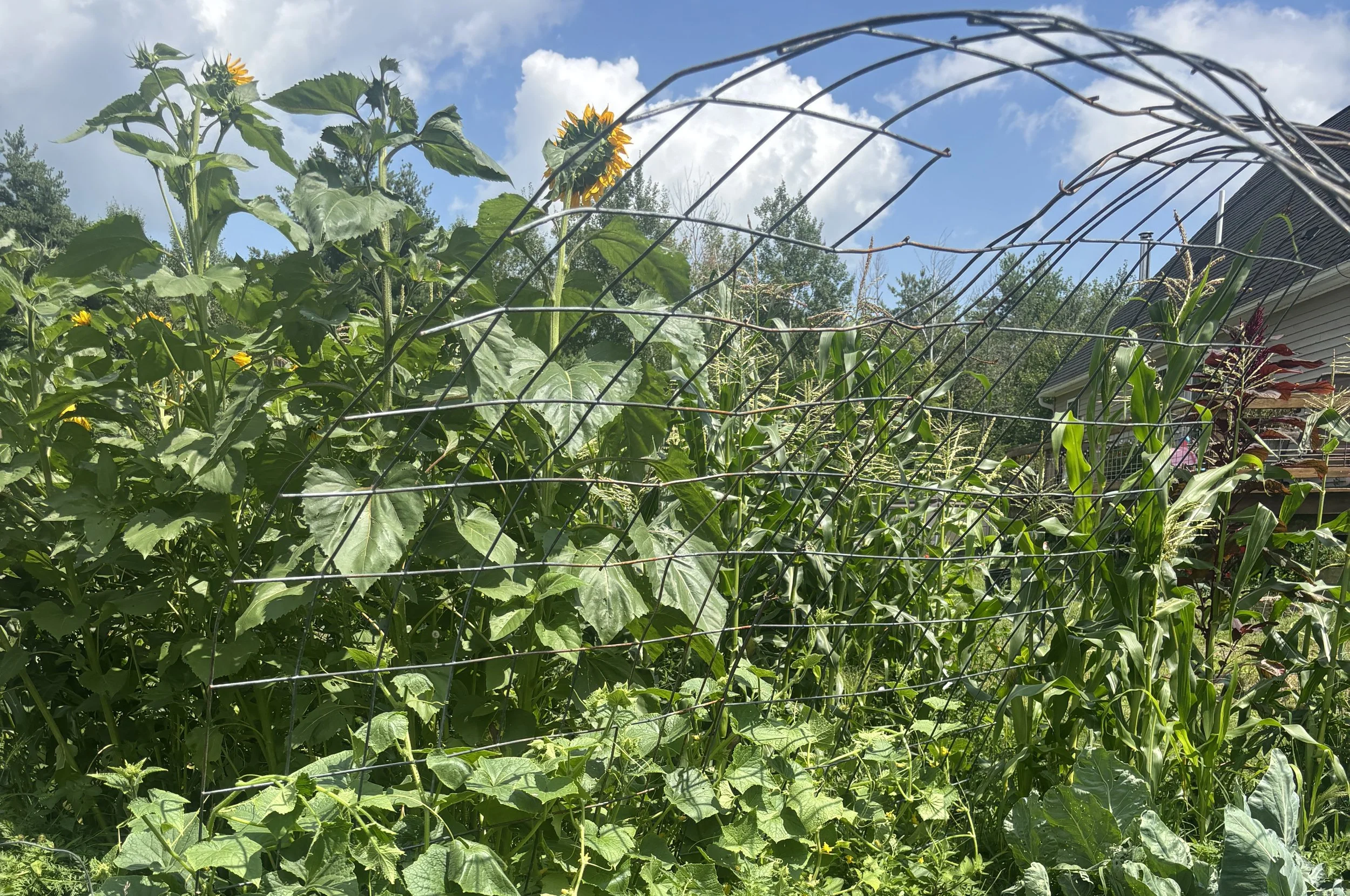
I don’t plant in neat, tidy boxes. While there is a little science in my approach (I recognize the value of companion planting and crop rotation and do follow those principles diligently from year to year), I don’t stress about spacing and I certainly don’t stress about a few weeds.
I’m not completely hands-off, either. I weed enough to keep the whole thing functional, weeding more in the spring and early summer to reduce pressure while the garden plants are young and still germinating. I still prune as needed, stake and trellis as needed (admittedly not as much as I should), and remove dying vegetation as needed.
But I’m not interested in controlling every square inch. I make sure there are always plants covering bare soil and use a weed whacker to trim vegetation that’s gotten out of hand instead of herbicides (those are off-limits for obvious reasons).
How I Plant My Chaos Garden
The most important strategy happens before I plant anything. A few weeks before planting time, I lay down paper mulch like this, then cover it with a thick layer of straw. When I’m ready to plant, I just punch holes through the mulch where I want seeds or transplants to go.
This accomplishes a few things for me:
Suppresses most of the early weed pressure
Keeps bare soil covered
Helps hold moisture
Reduces how much weeding I have to do later
Breaks down naturally instead of needing to be pulled up at the end of the season like black plastic
This approach works exceptionally well for me because I want a garden that can survive the fact that I have an actual life. I enjoy gardening. It’s a huge part of my life. But I don’t want it to become my sole focus.
There are weeks when I have plenty of time to work in the garden, but those weeks are few and far between. Most weeks, there are livestock chores, writing deadlines, family, travel, or unforeseen farm emergencies that take precedence, and my garden has to be able to tolerate that.
Neat little rows requiring constant attention and fussing are lovely, but they’re not me.
This is Not a Recommendation That You Trash Your Garden
Gardening advice (like all advice) gets weird because people tend to find something that works for them and then immediately turn it into a commandment. You must mulch this way, or you must prune tomatoes that way and it must be on a full moon. (I haven’t seen that one yet but really, would you be surprised?).
All of those opinions eventually become a moral judgment, and that drives me crazy. I’ve become suspicious of any agricultural advice that starts with, or includes, “should.”
What works beautifully here, in my garden and on my farm, might be an utter disaster in your backyard. Your soil is different, and so is your rainfall, growing season, pest pressure, available time, and goals. Hell, your tolerance for looking at a cucumber vine growing through a patch of calendula may be very different.
If you love perfectly straight rows and a weed-free garden, fantastic. If your gardening hobby is primarily about relaxing after work, you might want something completely different from someone trying to produce most of their family’s food.
And if you have three toddlers, a full-time job, six chickens currently escaping their enclosure, and exactly 11 minutes a day to garden, perhaps the horticultural standards of Monticello are not a useful benchmark.
My Garden Reminds Me That I’m Not in Charge
Chaos gardening, or “muster duck” gardening, or whatever you want to call it, is a great reminder that nature doesn’t care very much about our plans.
We can create the perfect conditions, improving soil, choosing seed, watering, weeding, fertilizing, pruning, and protecting until the cows come home.
But then June can deliver zero rainfall. Or rain for three weeks straight. A groundhog can discover the broccoli. Or a volunteer tomato can emerge from the compost pile and outperform the six plants I started under grow lights in February like they were members of the royal family (without fail, this happens every single year, to the point where I’m seriously considering not “deliberately” growing tomatoes anymore).
Nature is good at humbling anyone who starts believing they’ve cracked the code.
But you can’t control it at all. You can influence, nudge, respond, and sometimes, negotiate. But nature generally responds to carefully constructed plans by laughing directly (rudely) in our faces.
And maybe the mess is the point. My garden is never going to be the prettiest garden on Pinterest. Good. I already have enough things in my life that I’m supposed to “optimize.”
I don’t need zucchini that wins the blue ribbon at the county fair. What I want is food I can eat. Healthy soil. A place that’s resilient, where I can experiment.
I’ll keep planting my unhinged vegetable free-for-all, my Lord of the Flies garden.
The skill isn’t learning to control everything after all. It’s learning what actually deserves and needs our attention, what can be left alone, and when to just chill.
FAQ
What is a chaos garden?
A chaos garden is a mixed planting where vegetables, herbs, flowers, and volunteer plants are allowed to grow together rather than being kept in perfectly separated rows. The goal is to encourage diversity, keep soil covered, and pay attention to what thrives instead of trying to control every square foot.
Is chaos gardening really less work?
For me, yes, but not because I do nothing. I front-load a lot of the work by mulching heavily, getting plants established, and controlling weeds more aggressively early in the season. Once the garden fills in, I worry much less about perfect spacing, bare soil, volunteer plants, and every weed that pops up.
Is chaos gardening the same as companion planting?
Not exactly. Companion planting is usually more deliberate, with specific plants intentionally grown together because they may benefit one another. Chaos gardening is looser. I still use companion planting principles, but I also allow more mixing, volunteers, reseeding, and trial and error.
Do you still have to weed a chaos garden?
Yes, especially early in the season, when young vegetables are still getting established. I weed much more aggressively in spring and early summer, then back off as the garden fills in.
To offset the cost of website hosting fees, J&R Pierce Family Farm is a participant in the Amazon Services LLC Associates Program, an affiliate advertising program designed to allow sites to earn advertising fees by linking to products on Amazon, and the Google AdSense program.
